
SoW process explained: The Ultimate step-by-step guide [2026]
For commercial directors and procurement teams, moving away from unstructured resource hiring requires a deep understanding of the meaning of SoW in business. A statement of work is not simply a legal formality; it is a rigorous operational framework that defines project boundaries, sets measurable milestones, and ensures accountability from the specialist supplier.
In public sector technology projects, legacy procurement methods frequently lead to budget overruns and delayed rollouts. In fact, a 2024 Forrester Consulting study conducted on behalf of KPMG found that only 17% of UK public sector decision-makers consider their digital transformation completely successful. This systemic underperformance occurs largely because traditional time-and-materials hiring forces the purchasing organisation to absorb the majority of the commercial and delivery risk.
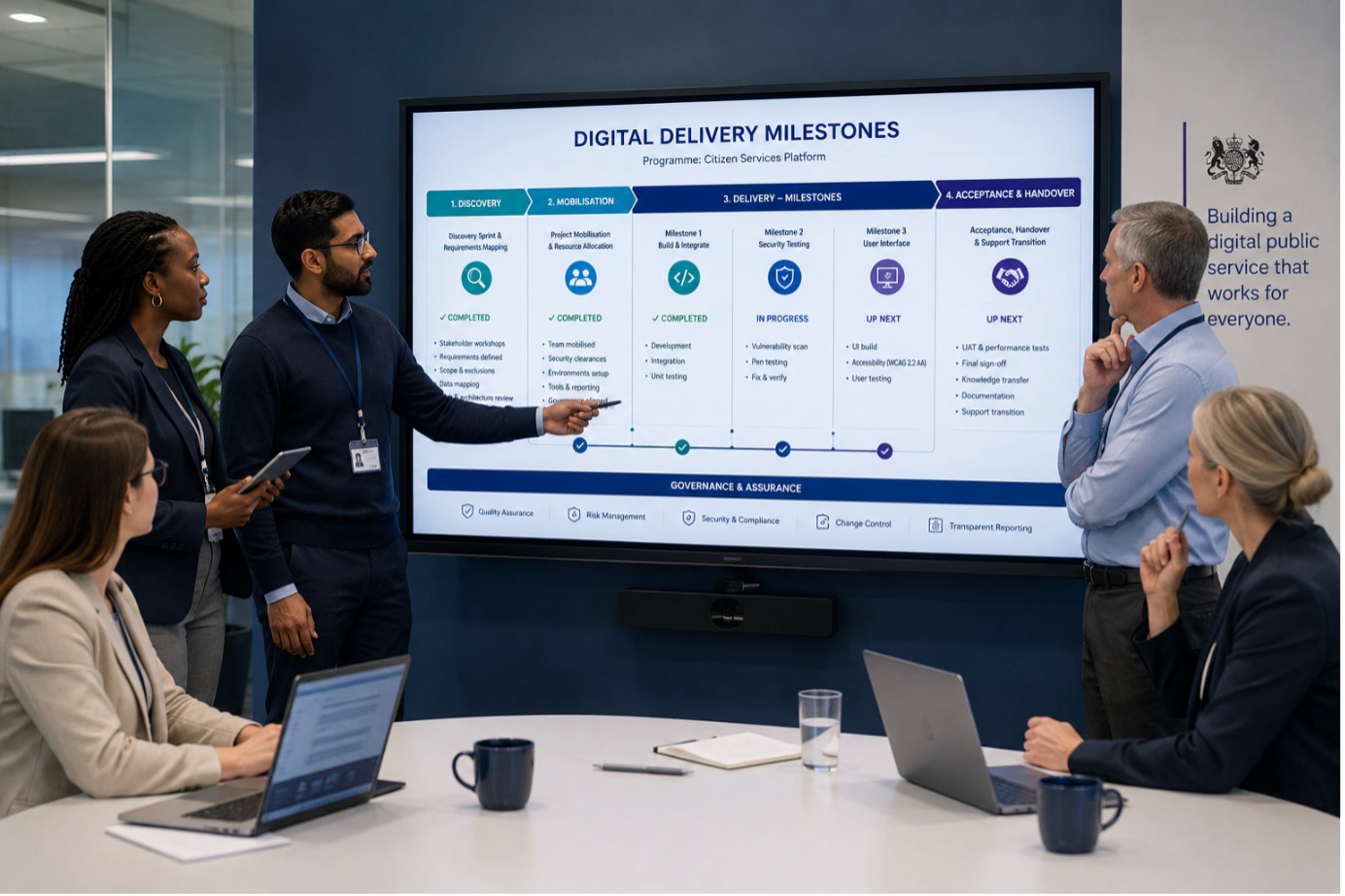
In this guide, you will discover the four critical phases of the digital delivery lifecycle, from the initial discovery sprint through to formal project handover. You will also learn how to navigate common procurement pitfalls and explore how a structured statement of work compares directly against legacy hiring models.
What is the true meaning ofSoW in business?
To successfully overhaul digital delivery, stakeholders must first establish the meaning of SoW in business contexts. In enterprise and government environments, a statement of work acts as the definitive source of truth for both the buying organisation and the digital delivery partner. It explicitly details what will be built, how long it will take, what regulatory standards must be met, and exactly how much it will cost.
Crucially, it transitions commercial risk away from the client and places it securely onto the supplier. Instead of paying a daily rate for technical contractors to attempt a task, the buyer pays a fixed sum for a guaranteed and verified result. If the supplier encounters technical difficulties or internal delays, they are financially responsible for remediating the work. This protects the public purse from endless billing cycles and ensures absolute financial predictability for project sponsors.
Phase one: The initial discovery sprint and requirements mapping
The foundation of any successful digital rollout is established long before a single line of code is written. Within a highly structured SoW process, the first phase of the delivery lifecycle focuses entirely on discovery and precise scoping.
During this crucial stage, Digital Squads collaborate closely with internal stakeholders to map out the exact requirements of the programme. This investigative work brings clarity to complex systems and typically involves engaging workshops, clear data mapping exercises, and practical technical reviews to audit existing IT architecture.
A robust discovery sprint actively prevents scope creep by documenting exactly what is included and, equally importantly, a strict list of exclusions. By clearly defining what will not be delivered, both parties avoid costly misunderstandings further down the line. The definitive outputs from this phase form a secure baseline for all subsequent delivery milestones, perfectly illustrating the meaning of SoW in business: establishing absolute clarity and shared expectations from day one.
Phase two: Project mobilisation and resource allocation
Once the detailed scope is agreed upon and formally signed, the initiative moves into the mobilisation phase. A highly effective SoW process relies on this critical step to rapidly deploy the right technical capabilities and bring the delivery plan to life.
For highly regulated public sector environments, mobilisation involves considerably more than simply assigning individuals to a workflow. It requires ensuring that all deployed members of your Digital Squad hold the necessary security clearances, establishing secure cloud environments, and integrating reporting tools directly with your internal programme management office. A structured mobilisation phase ensures that on day one of the delivery cycle, the team is fully equipped to begin building without frustrating administrative delays. Proper alignment here guarantees that complex standards, such as ISO 27001, are respected from the very outset.
Phase three: Delivery milestones and gated execution
The core of the execution phase relies heavily on milestone-gated delivery. To fully grasp the meaning of SoW in business, one must look at how large-scale software builds are handled. Rather than treating a build as one continuous and opaque effort, the project is divided into logical, highly measurable segments.
For example, a complex integration might be split into a beta development phase, a rigorous security testing phase, and a final user interface implementation phase. Each segment acts as a hard gate within your SoW process. The supplier must complete all tasks within a specific milestone and present the working software for review. The client then evaluates the delivery against pre-agreed specifications. Financial compensation is only released when the milestone is successfully cleared and verified. This gated approach enforces complete transparency and ensures that any technical challenges are addressed immediately, rather than compounding over the lifecycle of the programme.
Phase four: Formal acceptance criteria and project handover
The final stage of a highly governed SoW process involves rigorous user acceptance testing alongside the formal transfer of organisational knowledge. A project is never considered complete simply because the software has been built; it must be fully operational, secure, and seamlessly usable within the client's live environment.
Formal acceptance criteria are objective tests that the new system must pass before final sign-off. These testing parameters evaluate performance under load, data security protocols, and strict accessibility compliance, like achieving WCAG 2.2 AA standards. Understanding this final accountability gate is essential to grasping the true meaning of SoW in business, as it guarantees public funds are only released for a verified, working solution.
Once these criteria are confidently met, the supplier conducts a comprehensive handover. This handover protocol often features detailed documentation, recorded training sessions, and a managed support period to ensure your internal IT staff are fully prepared to maintain the digital asset independently.

How does a structured SoW process compare to legacy UK IT procurement?
To fully grasp the operational advantages of a modern SoW process, it is helpful to compare it directly against legacy procurement models frequently found in the public sector.
While this comparison highlights the clear operational advantages of an outcome-based model, successfully executing this transition requires a robust structural foundation. For a comprehensive breakdown of how to build this framework, including detailed strategies for mitigating risk and embedding compliance from day one, explore our comprehensive guide: Statement of Work (SoW): The Ultimate Guide for Regulated Digital Delivery.
How to secure project success through proactive governance
To maximise the benefits of outcome-based delivery, public sector bodies must implement strict governance and proactively manage operational risks. A well-managed SoW process guarantees successful milestone-gated public sector IT delivery by transforming potential vulnerabilities into strict quality controls.
- Defining explicit acceptance criteria: Ensure the definition of a completed task is crystal clear to enforce milestone gates effectively and prevent payment for subpar work. Maintaining this level of detail supports the true meaning of SoW in business, which hinges entirely on paying for verified results rather than just hours worked.
- Embedding accessibility standards early: Integrate accessibility and security requirements into the initial scoping phase to prevent expensive remediation work right before the scheduled launch date.
- Prioritising active stakeholder engagement: Consult internal users and department heads during the discovery sprint to guarantee the final product meets actual operational needs. Addressing this vulnerability is critical; according to the 2025 UK Digital Transformation report by ArvatoConnect, 53% of private sector organisations fail to gather end-user insight before introducing digital changes, creating an enduring "digital deficit".
- Enforcing documented change controls: Require any modification to the project scope to go through a formal and documented change request process to protect the integrity of the fixed-price agreement.
Bridging the execution gap: Where Satigo fits into the SoW process
Understanding the theory behind a highly structured SoW process is often only half the battle. For many public sector organisations, the primary challenge lies in securing the exact technical capability required to execute these rigorous, milestone-gated deliveries effectively. This is exactly where Satigo steps in to support complex digital transformations.
Satigo bridges this execution gap exclusively through the deployment of Digital Squads. Rather than supplying ad-hoc technical resources, this approach integrates a cohesive, multidisciplinary team directly into your secure environment. Your department retains complete ownership and oversight of the overarching programme, while the Digital Squad brings the precise delivery discipline required to build the software safely and predictably.
By engaging a Satigo Digital Squad, procurement leaders secure several critical operational advantages:
- Pre-qualified technical expertise: Rapid deployment of vetted specialists across software engineering, data architecture, and cloud infrastructure.
- Built-in public sector compliance: Delivery methodologies that naturally embed necessary security clearances and accessibility standards like WCAG 2.2 AA from the very first sprint.
- Framework-approved procurement: Seamless and compliant contracting through established UK public sector routes, including G-Cloud 14 and Tech Services 4.
- Total financial predictability: A delivery and governance model built fundamentally on the strict accountability of a fixed-price statement of work.
Ready to start your SoW process?
Mastering an outcome-based contract is a transformative step for any regulated organisation. By implementing a highly governed SoW process, public finance directors can effectively eliminate the risk of budget overruns and delayed deployments. At its core, the true meaning of SoW in business is about shifting your procurement focus away from merely paying for hours worked, and moving towards securing guaranteed, compliant, and fully functional digital services.
If your upcoming digital programme requires absolute accountability and a rapid injection of technical capability, leaving delivery to chance is simply not an option. Contact the Satigo team today to explore how our outcome-based Digital Squads can bring total predictability, strict governance, and secure execution to your most complex IT procurements.