Statement of work (SoW) agreements are legally binding documents that define the exact scope, objectives, milestones, and deliverables of a technology project. For public sector and highly regulated procurement leads, grasping the true meaning of a SoW is a foundational requirement for successful digital transformation. Unlike standard time and materials resource models, an outcome-led approach ties financial compensation directly to clear and audit-ready deliverables rather than mere hours logged on a timesheet.
In high-stakes environments such as public finance, central government, and national security, traditional procurement frequently stumbles due to vague requirements and a lack of supplier responsibility. For example, according to a 2025 National Audit Office (NAO) report, five critical government digital change initiatives experienced cost increases totalling £3 billion, representing a 26% escalation above initial forecasts. This highlights the severe financial risks of traditional approaches. Embracing this structured framework provides commercial teams with the mechanism needed to protect public funds while maintaining a relentless focus on delivery quality.
In this guide, you will discover what this model is and how it fits into regulated delivery. We will explore how it compares to staff augmentation, why milestone-gated acceptance is non-negotiable, and how to mitigate risk with compliance-first governance.
What is statement of work and how does it fit regulated delivery?
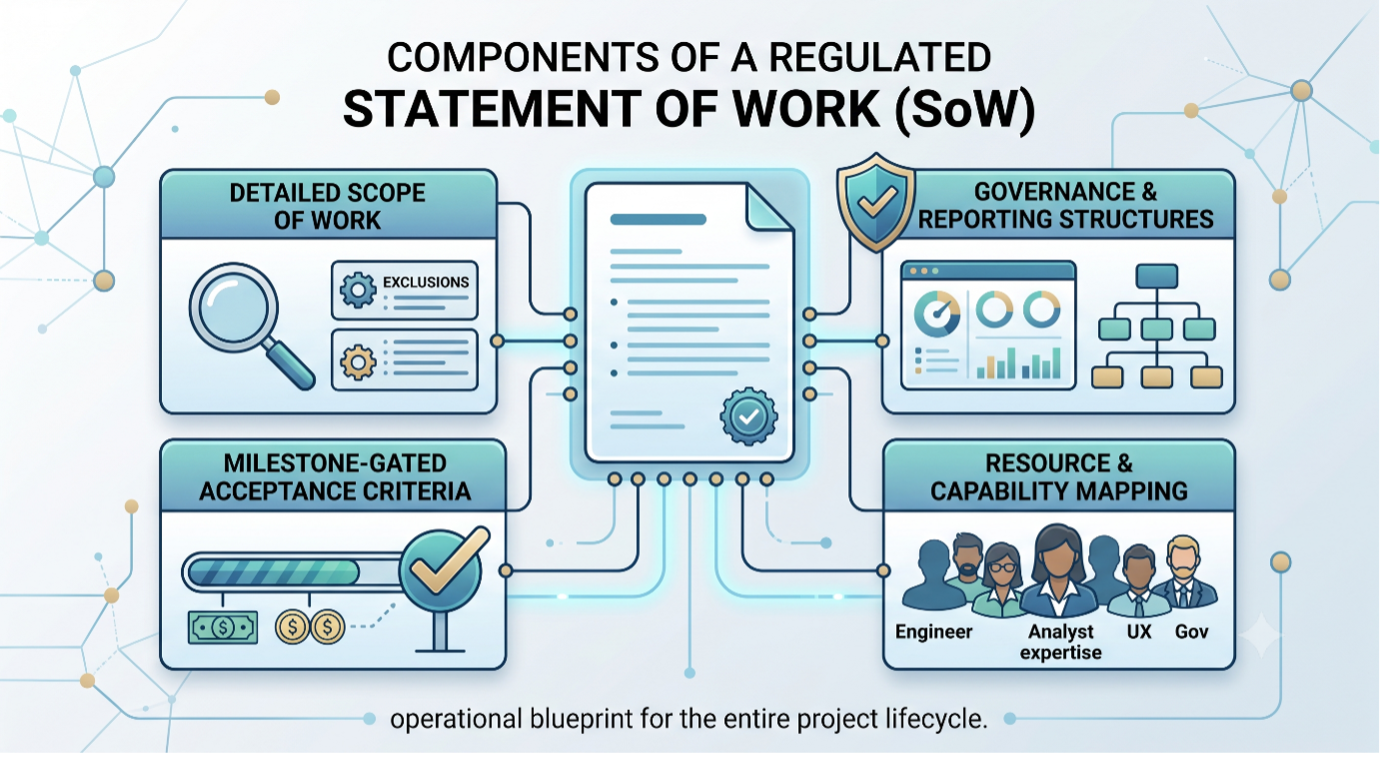
To truly understand the meaning of an SoW within digital transformation, organisations must look beyond basic contract templates. In highly regulated spaces, a statement of work (SoW) serves as the operational blueprint for the entire project lifecycle. It translates high-level strategic objectives into clear, non-negotiable delivery phases.
A fully compliant statement of work (SoW) typically contains several critical components:
- Detailed scope of work: An explicit breakdown of exactly what is included in the project, alongside a strict list of exclusions to prevent scope creep.
- Milestone-gated acceptance criteria: Clear and objective definitions of what constitutes successful delivery for each phase before any financial transfer occurs.
- Governance and reporting structures: An embedded and audit-ready framework outlining reporting intervals, escalation paths, and compliance checks.
- Resource and capability mapping: Definitive alignment of specialist skills to specific project phases, ensuring the right practitioners are deployed to the right tasks.
To see exactly how to implement these structural components into a project from the initial discovery phase through to final handover, explore our complete overview in SoW process explained: The Ultimate step-by-step guide [2026].
Statement of work (SoW) vs. staff augmentation: Which is best for UK regulated procurement?
When public sector leaders need to execute digital programmes, they generally face a choice between two main resourcing methodologies: staff augmentation or an outcome-based statement of work (SoW).
The staff augmentation model
Staff augmentation involves bringing individual contractors into an existing internal team. While this approach offers quick access to technical talent, it places the entire project risk squarely on the buying organisation. The client remains fully responsible for day-to-day management, strategic direction, and the final delivery outcomes. If a system rollout is delayed or fails completely, the financial burden rests entirely with the institution, yet the contractors continue to bill for their hours worked.
The scale of this financial exposure is immense; according to the 2025 State of Digital Government Review, the ongoing trend of bringing in contractors on a time-and-materials basis to complete technological tasks currently costs UK taxpayers £14.5 billion a year, frequently without securing the required digital outcomes.
The statement of work (SoW) model
On the other hand, an outcome-based statement of work (SoW) shifts the project risk directly onto the specialist digital capability partner. The supplier takes full ownership of the delivery process from the initial scoping phase right through to final user acceptance testing. This methodology introduces shared risk and absolute accountability into the procurement process, providing much greater security for public funds.

Why is milestone-gated acceptance non-negotiable for UK public finance?
In public sector procurement, achieving value for money is not just a secondary objective; it is a strict statutory obligation. Traditional time and materials arrangements often create misaligned incentives. In these scenarios, suppliers might inadvertently benefit from project delays by charging for extended development periods.
A modern statement of work (SoW) eliminates this friction through milestone-gated acceptance. This practical framework divides the digital programme into transparent and highly measurable phases:
- Discovery and alpha sprint: Scoping out data constraints, user requirements, and technical legacy architecture.
- Beta development: Designing, building, and security-clearing the core digital solution.
- Live deployment and handover: Testing to full compliance standards and executing a smooth knowledge transfer to internal staff.
Each milestone requires formal sign-off based on objective evidence before any funds are released. If a delivery squad fails to meet the pre-agreed acceptance parameters during a milestone review, the supplier must remediate the work at their own expense. This approach brings total financial predictability to public finance directors, ensuring that budgets always match actual and verified outcomes.
How can UK government bodies mitigate risk with compliance-first governance?
Regulated environments demand digital delivery that can easily stand up to intense internal and external audit scrutiny. When implementing complex technology platforms, organisations must ensure their statement of work (SoW) explicitly accounts for regulatory compliance from the very first day of the engagement.
An effective digital partnership embeds key international and local quality standards directly into the statement of work (SoW) deliverables:
- Information security: Ensuring all engineering practices, cloud configurations, and data migration workflows align strictly with ISO 27001 and Cyber Essentials certification standards.
- Accessibility compliance: Designing all public-facing services to achieve full WCAG 2.2 AA compliance, using plain English, clear typography, and thorough assistive technology testing.
- Framework alignment: Ensuring all procurement pathways match pre-approved UK public sector frameworks, including G-Cloud 14, Tech Services 4, and Digital Outcomes 7.
By codifying these vital compliance metrics within the contract document itself, public sector bodies avoid the common pitfall of treating security or accessibility as an afterthought to be resolved just before launch.
How to transition from headcount tracking to outcome delivery
Moving an organisation away from traditional contractor tracking towards a disciplined statement of work (SoW) model requires a deliberate operational shift. In fact, grasping the true meaning of an SoW involves understanding this exact shift from simply buying time to securing guaranteed results. Procurement leads can initiate this change by following a structured transition pathway:
Define clear operational boundaries
Before drafting the agreement, clearly articulate what the project needs to achieve. Shift the conversation away from requesting five developers for six months. Instead, focus on needing an automated and fully compliant data pipeline that integrates with the legacy ledger by the third quarter.
Settle on robust evaluation frameworks
Evaluate your potential digital capability partner based on their verified track record of delivery rather than abstract technical case studies. Look for specialists who demonstrate high rates of repeat business and possess a deep bench of pre-qualified, security-cleared practitioners.
Establish regular reporting rhythms
An outcome-led contract does not mean checking in only when the project concludes. Embed structured PMO governance into the statement of work (SoW) to ensure regular milestone reviews, risk registers, and operational health checks occur weekly.
How does a Statement of work (SoW) drive social value in UK public sector procurement?
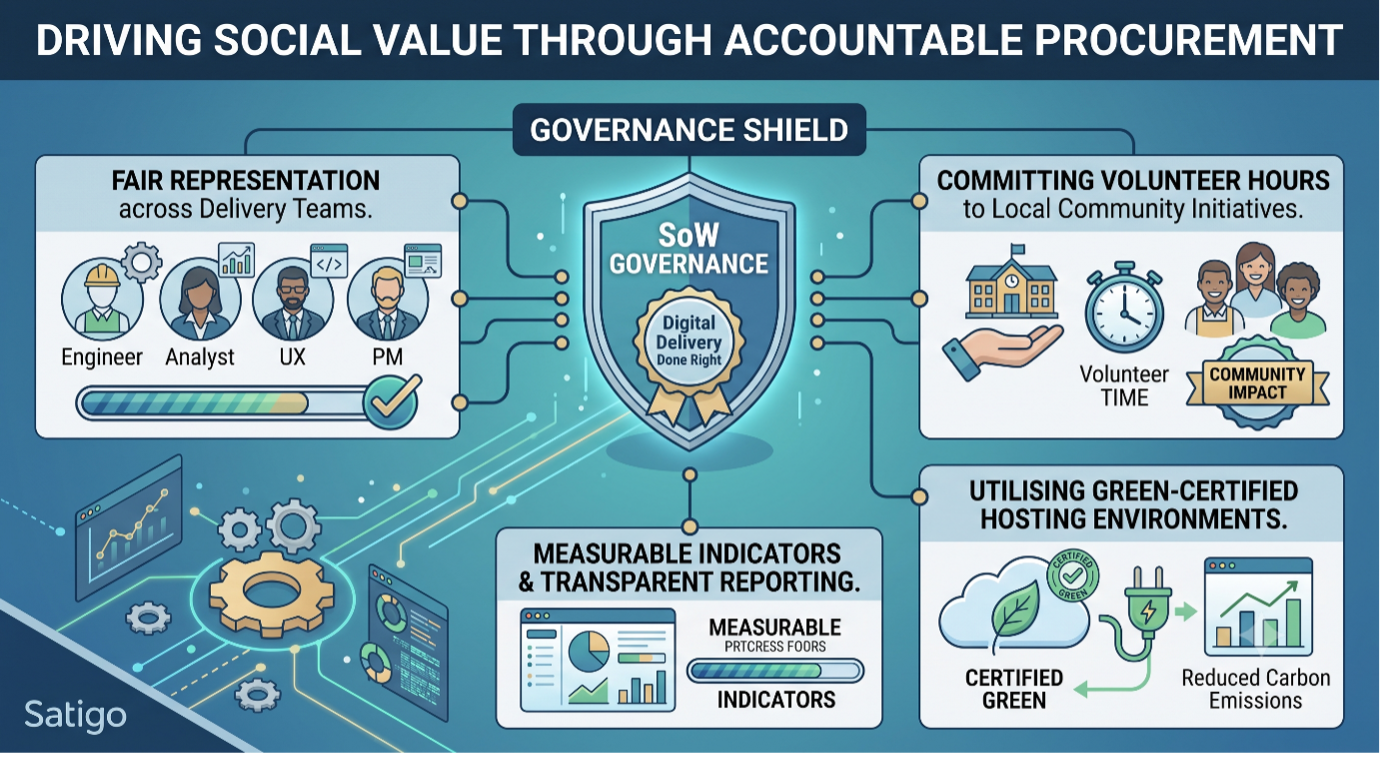
Modern public sector contracts must look beyond technical outcomes to assess wider community impact. An advanced statement of work (SoW) allows organisations to embed tangible social value requirements into the actual delivery mechanics of the contract.
When digital squads are mobilised under a comprehensive statement of work (SoW), the engagement can explicitly track and report on meaningful social indicators alongside core software milestones. This includes ensuring fair representation across delivery teams, committing volunteer hours to local community initiatives, and utilising green-certified hosting environments to reduce the overall carbon footprint of the digital transformation programme. This approach turns social value from a generic bidding response into a practical, reportable deliverable that benefits the wider community.
Bridging the gap with a digital capability partner
Transitioning to an outcome-based model requires a partner who deeply understands the strict demands of the public sector. This is exactly where Satigo fits into the broader picture of regulated digital delivery.
Partnering with experts who truly understand the meaning of SoW is essential to bring that operational blueprint to life. Satigo operates as a specialist digital capability partner, designed specifically to support organisations where governance, accountability, and pace are completely non-negotiable.
Rather than struggling to manage fragmented headcount, public sector leaders can utilise Satigo's Digital Squads. This service allows organisations to plug a fully governed, multidisciplinary team directly into their existing delivery setup. While the client retains ownership of the overarching project, Satigo brings the people, governance, and delivery discipline required to make it happen.
By engaging a Digital Squad under a rigorous statement of work (SoW), public sector bodies gain access to several distinct advantages:
- Pre-qualified specialists: Rapid deployment of technical experts across engineering, cloud, data, and delivery.
- Framework-approved pathways: Alignment with major UK public sector procurement routes, including G-Cloud 14 and Tech Services 4.
- Embedded compliance: Essential security and accessibility standards are woven directly into the delivery process from day one.
- Tangible social value: A firm commitment to tracking and delivering meaningful community impact alongside core software milestones.
To see how this methodology works in practice, procurement leads can explore Satigo's Digital Squads for a clear look at how rapid capability can be deployed without sacrificing control or accountability.
The strategic importance of an outcome-led partnership
Ultimately, modernising public sector delivery comes down to removing ambiguity from the procurement process. Grasping the true meaning of SoW means moving away from fragmented headcount leasing and choosing a collaborative approach that gives your finance and commercial teams total peace of mind. By anchoring every technology initiative to measurable milestones through a structured statement of work (SoW), your organisation eliminates the risks of budget overruns and ensures public resources are safely converted into lasting digital capability.
We know that navigating these complex digital transitions can feel daunting, but you do not have to do it alone. If you are ready to move your upcoming programme from a high-risk resource model to a governed and outcome-based framework, contact our team. Let us show you what digital delivery looks like when it is done right.