
The landscape of public sector recruitment is shifting as government-backed financial bodies and regulatory authorities face intense competition for elite talent. Relying on a traditional public sector recruitment agency to fill mission-critical posts is no longer viable for organisations operating with the sophistication of commercial banks. These entities must deliver complex digital change under strict statutory accountability, demanding a completely new approach to capability building.
This definitive guide explores how modern public institutions can secure transformational leadership and deploy pre-qualified digital squads at pace.

How do UK public finance bodies compete for top digital talent?
Modern public sector recruitment requires a deep appreciation of the complex environments in which government-backed financial entities operate. Institutions such as central banks, prudential regulators, economic development banks, national wealth funds, and payment oversight bodies are not conventional administrative units. They manage national balance sheets, oversee financial market stability, regulate systemic payments infrastructure, and direct multi-billion-pound infrastructure investments.
Consequently, these institutions compete directly for top-tier digital, quantitative, cyber, and operational leaders against the private financial sector. When an organisation seeks a chief data officer, a head of digital architecture, or an executive director of regulatory policy, an off-the-shelf public sector recruitment agency often fails to grasp the brief. Commercial talent from private banking or investment management frequently hesitates to navigate public sector recruitment channels unless engaged through discreet, peer-level headhunting that articulates the national impact of the role.
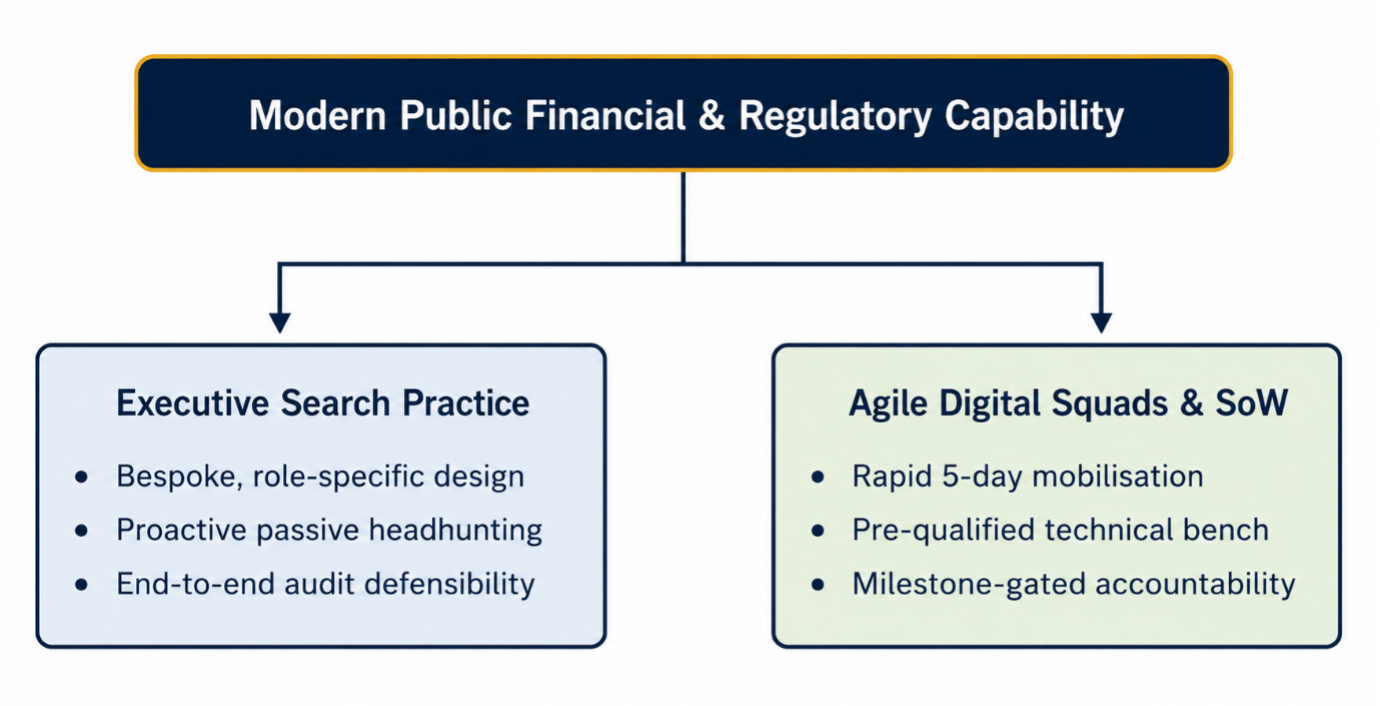
Why do traditional recruitment agencies fail in high-stakes public sector environments?
To secure transformational outcomes, public bodies must recognise where the conventional staffing model breaks down. A generalist public sector recruitment agency typically operates on high volumes and contingent margins. They publish generic job advertisements, filter inbound CVs against static keyword criteria, and charge placement fees without sharing any delivery risk.
In high-consequence environments, this transactional model introduces unacceptable operational friction. Sourcing talent for complex regulatory changes, cloud migrations, or payments modernisation requires active capability design rather than passive CV forwarding.
The table below outlines the operational distinctions between a legacy recruitment supplier and a modern digital capability partner.
When public sector recruitment adopts this partner-led approach, public organisations eliminate onboarding delays and align every appointment with long-term institutional goals.
How should government-backed organisations approach senior executive search?
Securing senior civil service professionals, regulatory directors, and board-level executives is fundamentally different from filling operational vacancies. High-calibre public sector recruitment cannot be treated as a one-size-fits-all process. Rather than forcing every search into a rigid assessment box, the entire acquisition journey must be shaped around the organisation, the role, and the specific level of appointment.
A mature capability partner like Satigo does not position itself dogmatically around standard testing. Instead, the assessment architecture is tailored to the exact leadership challenge:
- Defining what success looks like: The search begins by determining what the leader must achieve within 12 and 24 months, identifying the essential competencies, behaviours, and political acumen required.
- Modular assessment methodologies: Where appropriate, the partner integrates and manages psychometric assessments, scenario-based technical evaluations, strategic presentations, or multi-stakeholder panel interviews as part of a seamless journey.
- Proactive market mapping: Mapping passive talent across central government, private financial services, fintech, and regulatory ecosystems ensures the candidate longlist represents true market capability rather than active applicants alone.
- End-to-end search lifecycle: The partner manages every stage from confidential outreach and candidate screening to interview facilitation, referencing, compliance vetting, offer negotiation, and structured 90-day onboarding.
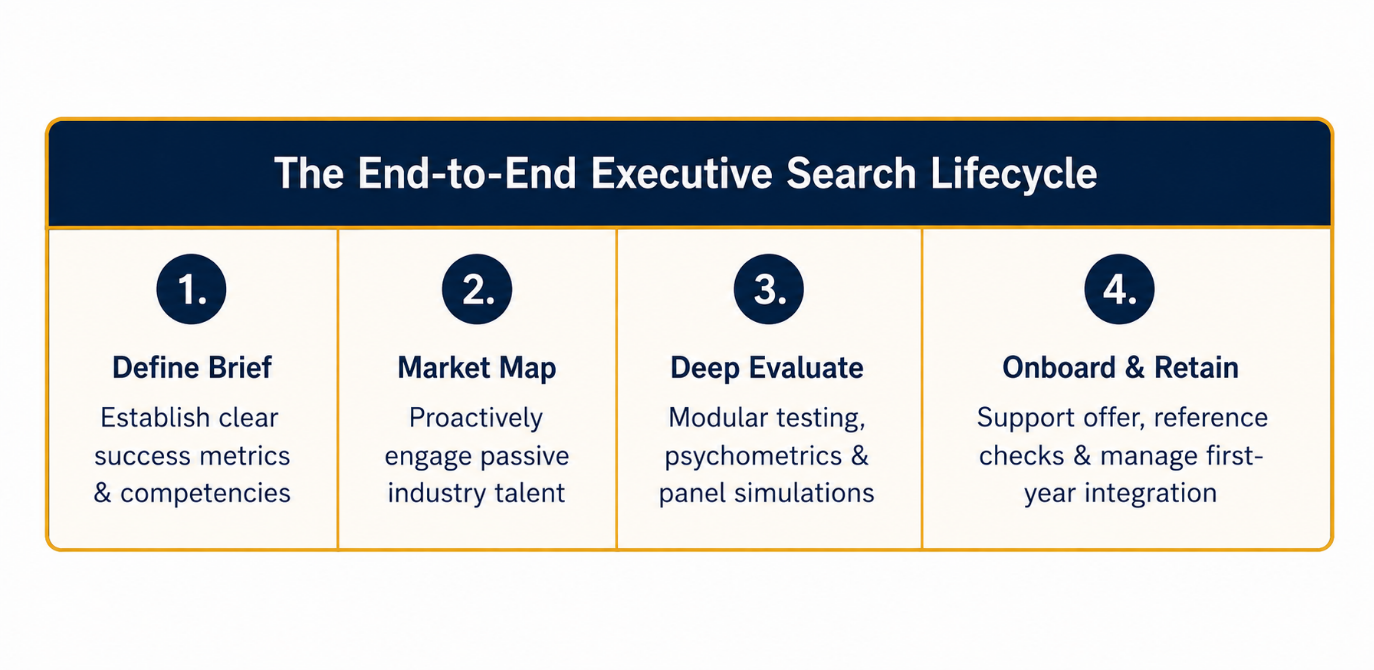
This structured thinking ensures that selection boards do not just review polished CVs from a standard public sector recruitment agency, but make defensible, evidence-backed senior appointments that withstand public audit.
How do pre-qualified digital squads solve UK public sector capability gaps?
Executive leaders set the strategic vision, but delivering complex digital change requires immediate technical capability. A common bottleneck in public sector recruitment happens when a new director inherits a skills gap, particularly during the severe 2026 shortage of product managers, delivery leads, and user researchers, but is blocked by headcount freezes or slow hiring processes. When project deadlines are fixed, waiting for a public sector recruitment agency to find contractors one by one simply takes too long.
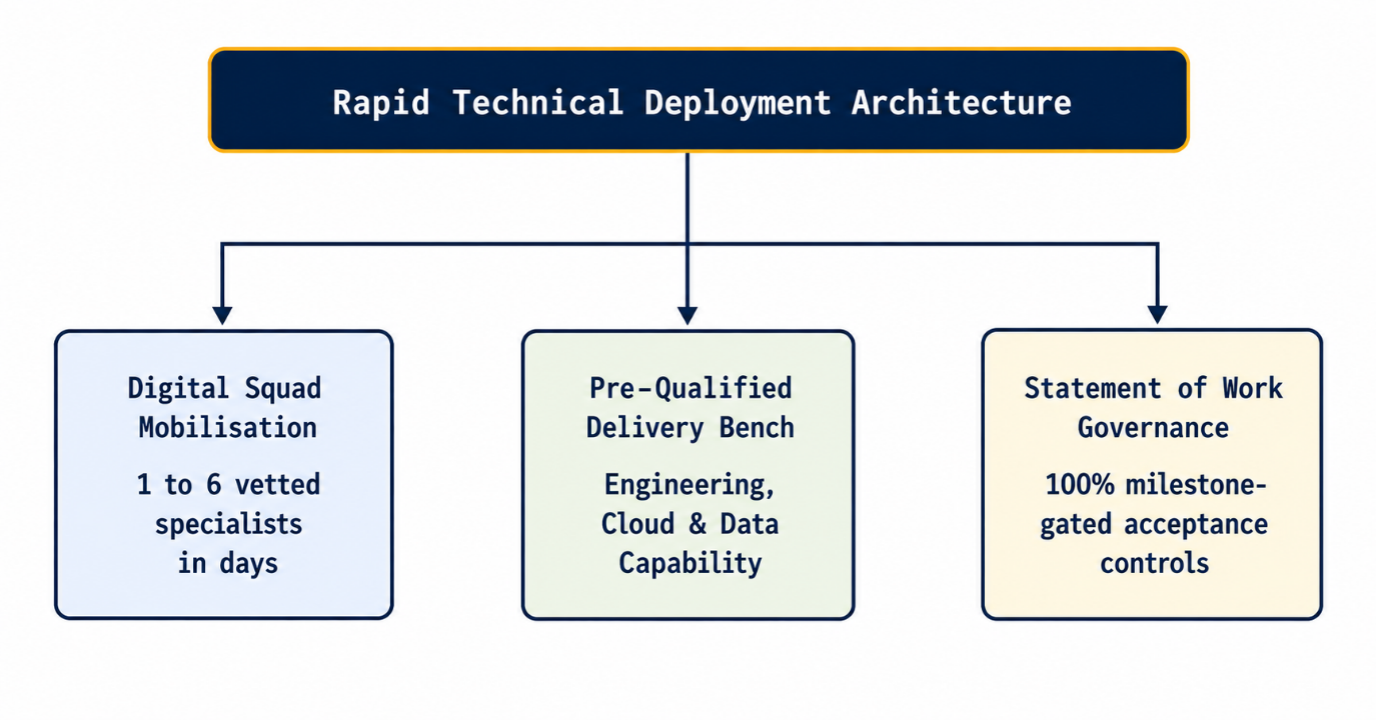
The modern solution is to bypass this delay by deploying pre-qualified digital squads:
- Rapid mobilisation: Access to an onshore bench of vetted specialists across engineering, cloud, data, artificial intelligence, and user-centred design deployed in days.
- Cohesive multi-disciplinary teams: Deploying governed teams containing lead developers, solution architects, and delivery managers who arrive ready to execute collaboratively from day one.
- Structured statement of work delivery: Work is scoped, priced, and delivered against clear milestone gates, transferring technical execution risk away from the public balance sheet.
Which UK procurement frameworks support compliant digital capability resourcing?
Public sector procurement leads must ensure that every engagement satisfies the highest standards of transparency, value for money, and statutory compliance. Directing public sector recruitment through pre-approved public procurement frameworks eliminates the administrative friction of standalone commercial tenders while providing audited legal assurance.
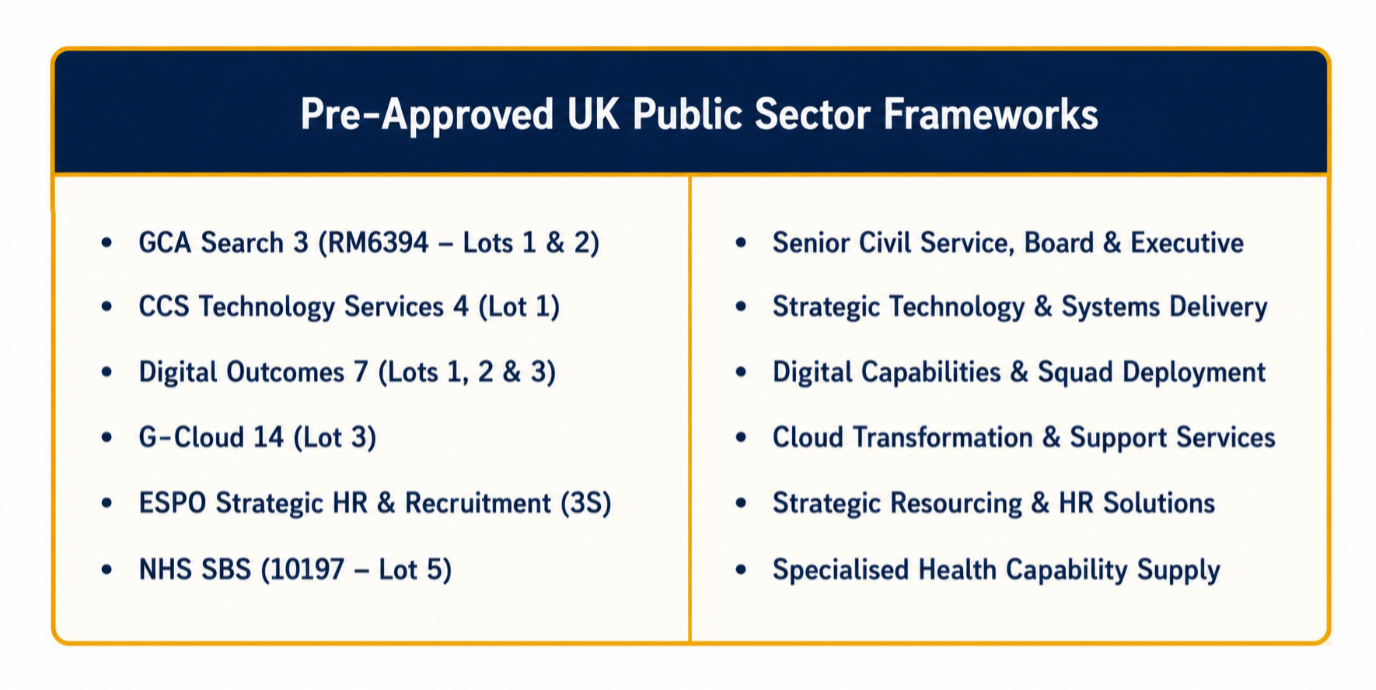
By procuring through these established lots, hiring authorities bypass prolonged tender timelines, knowing that suppliers have already met rigorous UK government operational, financial, and security baselines. Rather than managing unvetted suppliers from a random public sector recruitment agency list, departments engage pre-approved partners, like Satigo, holding accredited ISO 27001, ISO 9001, and Cyber Essentials certifications.
How can capability partners deliver measurable social value in the UK?
Modern public sector recruitment is inextricably linked to delivering measurable social value. In accordance with government procurement guidelines, public bodies require partners whose delivery models contribute positively to local communities, workforce diversity, and environmental sustainability.
A conventional public sector recruitment agency frequently treats social value as an afterthought. Conversely, leading capability partners build positive societal outcomes directly into their core delivery framework:
- Opening sustainable career pathways: Running structured digital bootcamps, workshops, and mentorship schemes that provide individuals from under-represented backgrounds with real routes into high-value technology careers.
- Diversity by design: Embedding representation targets from the initial longlist mapping stage, ensuring leadership shortlists consistently achieve 50% diverse representation without compromising merit-based assessment.
- Environmental stewardship: Operating digital-first, paperless workflows and green-certified cloud architectures to support public sector net-zero objectives.
- Accessibility standards: Designing citizen-facing digital services that comply fully with WCAG 2.2 AA accessibility standards, ensuring technology works for everyone.
What happens when a critical digital programme stalls?
The budget is signed, the statutory mandate is clear, and the regulatory deadlines are fixed. But what happens when a multi-million-pound transformation stalls simply because the right digital capability is not in the room?
Every month spent waiting for a standard public sector recruitment agency to forward generic CV profiles is a month of lost momentum and escalating risk. In high-stakes financial and regulatory environments, the cost of a delayed or misaligned appointment is measured in diminished public trust and failing infrastructure.
The question HR Directors and commercial leads must ask is no longer just how to fill a vacancy. It is how to secure a guaranteed outcome. Are your current resourcing methods genuinely built to deliver complex digital change, or are they merely filling empty seats?
If you need to rapidly mobilise pre-qualified digital squads or secure elite executive leadership through a fully defensible search process, it is time to change the approach.
Book a discovery call: Connect directly with a senior delivery lead for a 30-minute consultation on your context, constraints, and target outcomes.
Submit a statement of work: Provide your scoped brief to receive a shaped capability squad, costed delivery plan, and governance model within 48 hours.